What is Artificial Intelligence? A Beginner’s Guide (2026)
What is Artificial Intelligence (AI) and how does it work in 2026? This comprehensive guide covers the evolution of Artificial Intelligence, its types, and its impact on our future.
Artificial Intelligence (AI) is no longer a concept limited to science fiction movies or high-tech laboratories. In 2026, it has become a silent partner in our daily lives. Whether you are scrolling through social media, asking a voice assistant for the weather, or using a navigation app to avoid traffic, you are interacting with AI tools every day. But despite its presence everywhere, many people still ask: What is AI, and how is it actually helping us in the modern world?
The Evolution of a Digital Brain
In simple terms, Artificial Intelligence is a branch of computer science that aims to create machines capable of performing tasks that typically require human intelligence. This includes learning from experience, recognizing patterns, understanding complex languages, and making autonomous decisions.
Unlike traditional computer programs that follow a fixed set of instructions (like a recipe), AI is designed to evolve. Think of it like a digital brain. While a normal computer knows only what it is told, an AI system analyzes data to find its own solutions. This ability to “learn” is what makes AI the most revolutionary invention of the 21st century.
How Does AI Actually Work?
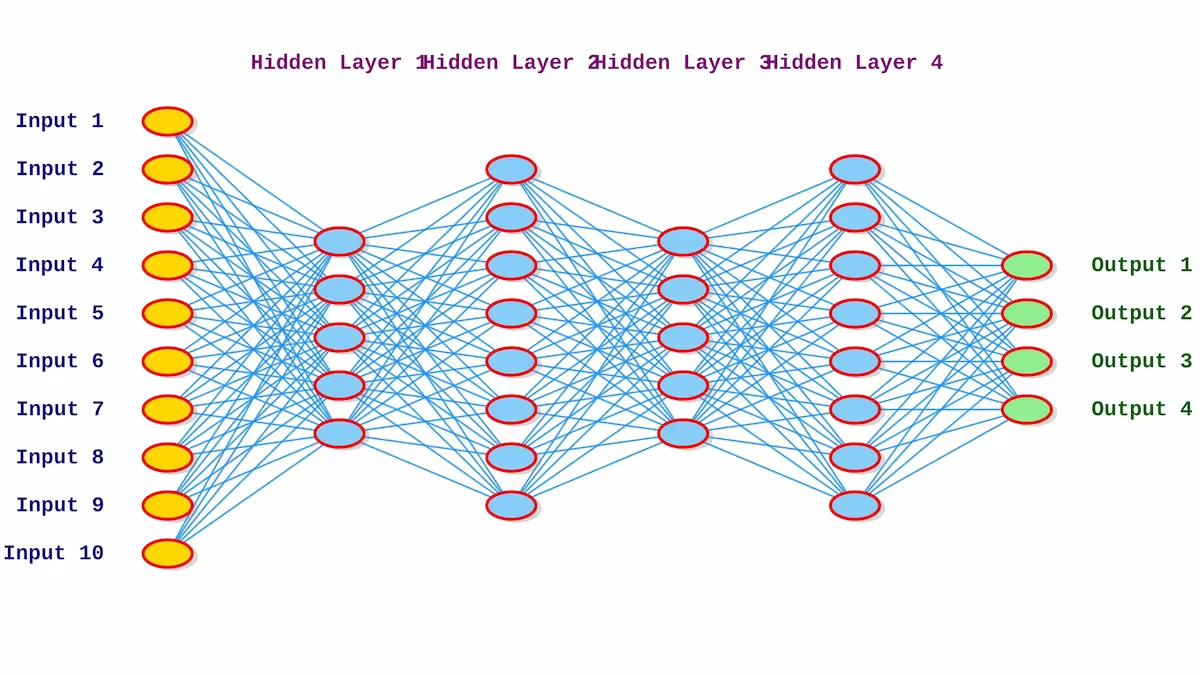
To the average user, AI feels like magic. You type a prompt, and it gives you an answer or a beautiful image. However, behind the curtain, it is all about Data and Mathematics. AI works through techniques such as Machine Learning and Neural Networks.
Imagine teaching a child to identify an apple. You show them different apples—red, green, big, and small. Eventually, the child’s brain recognizes the pattern of an “apple.” AI does the same. We “feed” an AI system millions of examples of data. Over time, the system builds a mathematical model that allows it to recognize objects, predict weather patterns, or even write a poem in the style of Shakespeare.
The Human-Centric Approach: Why AI Matters
At AI Tool Vista, we believe that AI is not here to replace humans but to empower them. It acts as a multiplier of our own capabilities. If a human can research a topic in five hours, an AI can help them do it in five minutes. This doesn’t take away the human’s role; it gives the human more time to think critically and creatively.
A Brief History: From Dreams to Reality
The journey of Artificial Intelligence began much earlier than most people realize. In 1950, the legendary mathematician Alan Turing published a paper titled “Computing Machinery and Intelligence,” where he proposed the “Turing Test” to determine if a machine could truly think. However, the term “Artificial Intelligence” was officially coined in 1956 at the Dartmouth Conference.
For decades, AI went through periods of great excitement followed by “AI Winters”—times when progress stalled due to a lack of computing power. The turning point came around 2010. With the rise of the internet providing massive amounts of data and the development of powerful GPUs (Graphics Processing Units), AI finally had the “fuel” and the “engine” it needed to move at lightning speed.
The Three Main Types of AI
To understand the current landscape, we must distinguish between the different categories of AI:
- Narrow AI (Weak AI): This is the AI we use today. It is designed to perform specific tasks, such as facial recognition, internet searches, or driving a car. It is brilliant at its job but cannot do anything outside its programmed scope.
- General AI (Strong AI): A theoretical form of AI that would be able to understand, learn, and apply knowledge in the same way a human does. We have not reached this stage yet.
- Generative AI: This is the latest breakthrough (like ChatGPT and Midjourney). It doesn’t just analyze data; it creates new content, including text, images, and even music, based on the patterns it has learned.
[attachment_1](attachment)
How AI is Helping Humanity Today
The true power of AI lies in its ability to solve problems that were once considered impossible. Here is how it is making a difference across various sectors:
1. Revolutionizing Healthcare
AI algorithms are now capable of analyzing medical images (like X-rays and MRIs) with a level of precision that rivals expert doctors. It helps in early cancer detection and is significantly speeding up the process of drug discovery, saving years of research and millions of lives.
2. Education and Personalized Learning
Every student learns differently. AI-powered platforms can adapt to a student’s individual pace, identifying their weaknesses and providing customized lessons. This makes quality education more accessible to people regardless of their location.
3. Productivity and the Global Economy
From automating repetitive tasks to helping software developers write code faster, AI is a massive boost to global productivity. It allows human workers to move away from “boring” tasks and focus on creative problem-solving and strategy.
The Ethics of AI: Will It Replace Us?
A common concern is whether AI will take over human jobs. While AI will certainly automate some roles, history shows that technology creates more opportunities than it destroys. The goal of AI Tool Vista is to show you that AI is a tool—a sophisticated hammer or a digital pen. It requires a human hand to guide it. The future belongs not to AI alone, but to humans who know how to collaborate with AI.
Conclusion: Embracing the Horizon
Artificial Intelligence is the most transformative tool of our generation. It is a mirror reflecting our own intelligence and a bridge to a more efficient future. By understanding how it works and learning to use it responsibly, we can unlock doors to creativity and innovation that we never thought possible.